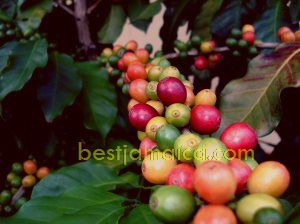
Jamaican Blue Mountain Coffee is a hot commodity on the world market. Most noted for its lack of bitterness, full body and aroma. It fetches top price because of the quality beans coupled with the relatively low supply. It is grown in a specific area of Jamaica where the temperature and biodiversity is just right to produce the world's best coffee. For this reason the demand always exceeds the supply.

The coffee bean is actually a berry that grows on shrub. These shrubs thrive best in tropics which have temperate temperatures. However, although the shrubs do well in these conditions the ideal temperatures are between 60 to 80 degrees. Lower temperatures will cause damages to the foliage and the trunks of the plants, while higher temperature slows the growth.

Jamaica, Colombia, Costa Rica, Java, Guatemala, Kenya, Peru and Sumatra are some of the best known coffee producing countries. While almost all coffee from these countries are of good quality, different conditions and growing methods can alter the taste one way or another.

This coffee is grown on the Blue Mountains of Jamaica which peak at 7,403 ft. The climatic conditions along with the natural organic materials which exist there are just perfect. At this altitude the average temperature is about 65 degrees which makes it ideal for the growing of the coffee. The rainfall is right in balance and the drainage is not a problem because they are grown on slopes.

These berries are unique in certain ways. The beans inside are benefited from the outer part of the fruits. Like other fruits, the slower they arrive to maturity is the better the taste. In this case these berries do better when grown in a climate that has a big swing between day and night temperatures. This slows down the maturing process, which resulting in beans that lack bitterness while contributing to its beautiful aroma.

Stevert Mckenzie, Travel Enthusiast.
http://www.bestjamaica.com/jamaican-coffee.html

Everything Montego Bay Jamaica

MONTEGO BAY • JAMAICA TRAVEL GUIDE AIRPORT + CRUISE GATEWAY

Montego Bay, Jamaica: The Tourist Capital (What to Know Before You Go)

Beaches, culture, nightlife, and the island’s busiest arrival hub — packed into one city.

Montego Bay is Jamaica’s most recognized vacation city for a reason: it delivers an easy mix of resort comfort and real Jamaican energy. You can spend the morning on a calm beach, grab local food for lunch, explore the city in the afternoon, and still have a full night out when the sun goes down. It feels international, but it doesn’t lose its personality — the music, the pace, the warmth, and the culture are always right there.

Geographically, Montego Bay sits on the island’s northwestern coast — a convenient launch point whether you’re heading east toward Ocho Rios, or west toward Negril. This is also why the city is often called the gateway to Jamaica: it’s home to Sangster International Airport (MBJ), one of the island’s main arrival points, and it also supports cruise arrivals and day visitors. In simple terms: if Jamaica is your destination, Montego Bay is frequently your first stop.

Quick Montego Bay snapshot
  • Best for: easy arrivals, beaches, nightlife, and quick access to north-coast attractions
  • Vibe: resort-friendly, lively city feel, with quiet pockets when you want to relax
  • Don’t miss: a beach day, local food, and an evening on the Hip Strip

A big part of Montego Bay’s story includes Doctor’s Cave Beach — one of the earliest famous attractions in the area. Over time, the city became linked with “fun and relaxation,” and that reputation still holds. You’ll find white-sand shorelines, restaurants serving both local and international flavors, fresh fruit everywhere, and that unmistakable island atmosphere that makes people fall in love with Jamaica.

If you enjoy nightlife, Montego Bay shines after dark. Gloucestershire Avenue — better known as the Hip Strip — concentrates restaurants, bars, pubs, beach parties, and duty-free shopping into one easy-to-navigate stretch. If you’re the type who likes to explore, your only challenge will be deciding where to start.

For travelers who want activities beyond the beach, Montego Bay is also a strong base for adventure: river tubing and rafting, snorkeling, catamaran cruises, zipline experiences, horseback riding, and a long list of day trips along the north coast. You can build a relaxed holiday, an action holiday, or a mix of both — without feeling stuck in one mode.

Planning your arrival?
Reserve dependable rides and keep your trip running smooth.

The Caribbean is a cruise ship paradise. Yes more ships cruise go to these beautiful islands than any other region in the world. The islands in close proximity to each other which plays a big role. Cruise ship companies normally offer a package where one be able to visit 4 or 5 countries at a minimal cost.

The major drawback of a cruise is that one doesn’t get to spend enough time at any one place. In fact passengers spend more time on the ship than on land. Typically, if the ship is not docked overnight then one has to settled with only eight hours of Island fun.

http://www.bestjamaica.com

However, not to worry though these modern built vessels are nothing less than a big floating 5 star hotel. Everything one can imagine is available and this definitely makes up for the limited time spent on land.
THE PRINTED word can be traced back in Jamaican history to the early 1700s. Printing began in 1718 with the publication of the Weekly Jamaica Courant, which holds the distinction of being the second regular newspaper in the Americas. Unlike in the Spanish and Portugese colonies where printing was used as a means of spreading colonisation, in the British colonies where sugar was the primary focus printing arrived slowly, more as an administrative tool a commercial vehicle.

In a 1717 dispatch to the British Council of Trade and Plantations Jamaican Governor, Sir Nicholas Lawes, describes printing as "of great use and benefit for public intelligence, advertisements and many other things...' (Cave, 1975, p. 12). He noted the usefulness of local newspapers to commerce and advocated for the establishment of a Jamaican press, helping to make Jamaica a centre of printing in the New World. Lawes' attitude marked a significant change in the perspective that had prevailed during the 1600s when printing was closely regulated by the government and restricted to London, specifically to Cambridge and Oxford Universities. During the latter half of the 17th century, following the Restoration of King Charles II, printing was severely controlled all unlicensed books and printing equipment were regularly subject to seizure. It was not until 1693 that the Licensing Acts that had so strictly regulated printing were loosened, and within a very short time printers spread all over England. Local newspapers abounded. In the colonies, however, progressive attitudes like Lawes' were slow to evolve. Many administrators were wedded to attitudes such as that of Virginian Governor Berkeley, who in 1671 thanked God there are "no free schools, nor printing, and I hope we shall not have, these hundred years; for learning hath brought disobedience and heresy and sects into the world, and printing has divulged them, and libels against the best of government. God keep us from both" (as quoted in Cave, 1975, p. 11.).
PRINTING COMES TO CHURCH STREET


Not long after Lawes' 1717 dispatch, Englishman Robert Baldwin established his printery on Kingston's Church Street. Not surprisingly, Baldwin's first publication is noted as "A Pindarique Ode on the Arrival of his Excellency Sir Nicholas Lawes, Printed by R. Baldwin in Church Street in Kingston, MDCCXVIII." It is possible that Baldwin was awarded the sole licence to print on the island. He made a wise choice in locating his new venture in Kingston because it enabled him to have relatively equal access to both Spanish Town and Port Royal the island's two main towns.
Baldwin arrived in Jamaica with a wooden printing press with Dutch types. A meticulous man, he was conscious that the types might be hard to repair in Jamaica so he brought close to 20 cases of type with him. Some were still in use close to 3 decades later, long after his death. Baldwin also anticipated that paper supply would be a potential problem, so he also carried large stocks of paper of varying size. He did not arrive with any ink, however, which leads one to believe that he, like famed American printer Benjamin Franklin, made his own.

http://wwww.bestjamaica.com

The Ubiquitous Banana

The banana is one of the most popular and versatile fruits in the world. It is a native of Southeast Asia but as found itself in all the other tropical countries today where is enjoyed as a fruit, to make fiber or as ornamental plants. It presently cultivated in over 107 countries with the United States and the European Union the chief importers of about 15% of the worlds production.

The nutritional and health benefits of this fruit is far reaching making it a wonder fruit. It contains three natural sugars- sucrose, fructose and glucose and it is good source of fiber which makes banana the best natural supply of instant and sustained body energy. It is the most popular fruits among athletes who used a lot of energy. Two bananas provide enough energy for laborious hour and half work out.

This tropical fruit is also high in potassium yet low in salt, it is like having your cake and eat it too. The fibre that it possesses can help restore normal bowel action without resorting to the unpleasant taste of laxatives. The vitamin B6 it contains regulates blood glucose levels which can affect your mood positively. Bananas can also help in the process of quitting smoking, it is packed with Vitamin C, A1, B6, B12 as well as potassium and magnesium which help the body pull away from the effects of nicotine withdrawal. Perhaps banana is one of the best natural source of iron making it perfect for the anemic.

Today the products of this fruit are quite ubiquitous, this is evident on the supermarket shelves, restaurants, bars, snack counters among other places. There is a wide range of products which the banana is the main ingredient ranging from alcoholic beverage to plain simple deserts. Here are a few of the common products to have been made from this versatile fruit.

The Banana beer is an alcoholic beverage made from fermented mashed bananas with an alcohol content of 4.8%. The Banana bread is made of mashed ripe yellow bananas, the banana ketchup, the banana sauce which is a sweet mixture made to top ice creams and other deserts. The famous desert the banana split, banana milk shake and the list continues. This super fruit is versatile, tasty and healthy and should be incorporated in our daily menu in some form.

Stevert Mckenzie, Travel Enthusiast.
http://www.bestjamaica.com

Why Jamaican Jerk Chicken is Healthy

Eating Jamaican jerk style food could be healthier than other grilled or barbecued meat. It is believed that meat grilled over high heat could increase the risk of cancer. If this is so then we need to be careful on how we prepare our foods. The popular belief from the experts is that marinating meat well for at least thirty minutes prior to cooking will decrease this deadly risk. They went on to say that marinating with garlic, rosemary and sage will lessen the peril as well.

However, one of the main ways of minimizing this risk is to grill the meat over low heat. Make sure that it is cooked properly but not burned. The real danger forms when the meat is burned and this certainly happens when done over high heat.

Jamaican jerk style food when done properly is all that the experts have recommended reducing the risk of endangering ones health. Grilled meat is a favorite on the island which started as way back with the tainos and awarak indians.

The Jamaican cuisine underscore by marinating meats for long periods. There is no specific time range but best result is when left overnight in the refrigerator. It is then place over low heat which should be cook very slowly but thoroughly.

It is very important that when making Jamaican jerks the meat must not be place too close to the source of the heat. This will ensure that the meat doesn't get charred and under prepared. Generally three hours of grilling slowly should be sufficient. A thermometer is recommended to ensure proper temperature.

If you happened to visit Jamaica on a vacation or business be sure to enjoy some of the lovely delicacies on the island. Famous for many things this lovely island as the flavors and tastes that one can indulge in without fear. Rock to the reggae beat, enjoy the cuisine, sample the rums, go to the beach and bask in the sun.

Stevert Mckenzie, Travel Enthusiast.
http://www.bestjamaica.com